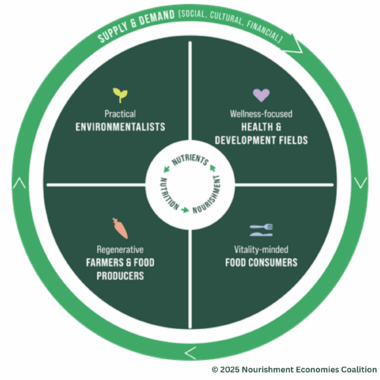
In February, our Nourishment Economies Coalition convened 16 senior social entrepreneurs from Tanzania, Uganda, Malawi, Rwanda, Kenya, Zambia, and the United States. Each engages thousands of small farmers in innovative health, food, nutrition, and/or environmental conservation initiatives. By focusing on economic overlaps of these sectors, we prioritized seven direct actions for connecting and spreading new approaches in various places.
By the month of May, additional field visits and planning had solidified initial steps and concept notes for larger actions. Each new initiative involves 2-5 social entrepreneurs in multiple countries, reflecting engagement with over 500 000 small farmers across East Africa:
(1) Create valuable new field data and finance for farmers and environmental, public health, and business interests: Develop Africa’s first rigorous pesticides and plant species data system that sources annual data by analyzing millions of honeybee pollen samples sourced from small farms. Do this in partnership with our Coalition colleague BeeOdiversity in Belgium, who developed the science and data system enabling this approach in multiple countries, but has never combined it with the reach of small farmers across wide territories. The approach often identifies and tracks over 100 distinct plant species and concentration of any of 520+ potential pesticides at sites averaging 700 hectares / 1800 acres in size, and can connect this data across multiple sites in small or large regions.
(2) Help farmers realize multiple values of soil stewardship by spreading the innovative “smallholder soil health toolkit.” Initial steps include working with a young entrepreneur and an enterprise incubator in Uganda to launch a new regional soil health enterprise; increasing social-side R&D for the toolkit with two farming/training hubs in Kenya; and testing integration with a 55000 farmer native foods company in Zambia.
(3) Create a line of finance for small farmers by developing a new carbon credit approach combining these locally led initiatives across countries, in order to benefit the small farmers directly and reach significant scale of carbon sequestration. The Akili Group in Kenya is steeringthis process with the other participating social entrepreneurs, to standardize operating and financial protocols that emphasize local farmer leadership, local economics, and regenerative practies that generate other tangible benefits as well.
(4) Spread demand-side markets and supply-side infrastructure for native food crops which are resilient, nutritious, and culturally engaging, but neglected in dominant commercial food systems. Start with a Uganda-Zambia partnership to synthesize approaches our Coalition member Sylvia Banda used to network community farmers and build markets with national restaurants, supermarkets, and food programs based on the flavors, aromas, and cultural traditions of traditional local foods.
(5) Develop university curriculum that adds these economic insights, and this underlying economic framework, into Bachelor of Science degree programs in sustainable agriculture. Prototype this in applied curriculum with faculty and administrators at the nationally accredited African Rural University (ARU).
(6) Conduct search and selection of 10-20 new Ashoka Fellows in this field: Surface and accelerate a next generation of world class, systems-changing social entrepreneurs and their insights and innovations at the overlap of health, food, environment, and other profound socioeconomic forces. Similar work 8-10 years ago by Ashoka, a founding member of the Nourishment Economies Coalition, surfaced and vetted many of the dynamic people, approaches, and patterns of ideas and trends that continue inspiring other actions to this day in regenerative and agroecological movements, women’s leadership, nutrition-repleteness, rural youth talent and employment and more.
(7) Standardize a set of tools making the examples, business models, underlying insights, and collaborators accessible in a wider range of communities, institutions, and schools. I.e. a Nourishment Economies toolkit (or guidebook), including an “Africanized” version, synthesizing the approaches, data, underlying science, and formal economics framework that succeeded in framing and sparking all these new actions at our recent Action Summit.
In addition to these immediate action opportunities, additional learning topics emerged among this group, such as potential for spreading ARU’s applied learning approach in community epicenters, how these insights can also stimulate hyper-local actions (e.g. among tens rather than thousands of people at a time), how to integrate this economic framework into regional and international agroecological startup and finance programs (alongside or in contrast to less holistic/more typical economics in society), customizing the economic framework for youth-led initiatives, the clear alignment between the nourishment-cycle economics and a great deal of indigenous knowledge and practice, and technical topics like biochar or sources of healthy phytonutrients in foods. Two learning exchanges have already taken place, for example, between staff of FIPS Africa in Kenya and ARU in Uganda.
Click here for a copy of our East Africa Action Summit agenda and participants.
Comment below for additional information on any of these topics.